U2 and Philosophy by Mark A. Wrathall
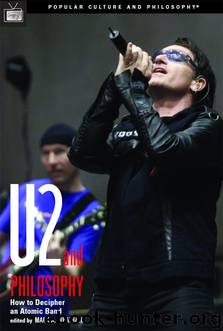
Author:Mark A. Wrathall
Language: eng
Format: epub
ISBN: 9780812698138
Publisher: Open Court
What Makes a Reaction Reasonable?
U2 acts as well as hopes—and presumably acts in part because it hopes. They joined other artists in opposing South African Apartheid. They worked to bring world attention to the suffering in Sarajevo (during the Yugoslavian civil war). The most impressive and visible example along these lines is Bono’s work to help poor countries shed their debt and to address AIDS in Africa.4 This all illustrates a third aspect of U2’s reaction to evil: active participation in God’s work of making things right, a work which, though it won’t be completed in this life, has already begun.
So how should we evaluate U2’s reaction to evil, a reaction that includes anger at God, hope for heaven, and laboring to set things right? Specifically, how does it compare to that of XTC, which concludes that there is no God? Which reaction is more reasonable, sensible, and appropriate?
I shall not consider anger, which both XTC’s and U2’s reactions share. After all, since they react alike in this way, there is no question—in this regard—of which reaction is more reasonable than the other. Likewise, I’ll set aside U2’s humanitarian efforts. For everyone should agree that such a reaction to evil is reasonable. Besides, there is no reason why XTC couldn’t work against evil too (and, for all I know, maybe XTC already does).
Let’s focus on the part of XTC’s reaction that includes the belief that God does not exist. And let’s focus on the part of U2’s reaction that includes the belief that God does exist and will redeem evil and will make things right one day. This is the fundamental difference between their two reactions. And thus the fundamental question here is which of these beliefs is a more reasonable reaction to evil.
Perhaps someone’s atheism is reasonable for reasons having nothing to do with evil. And perhaps this atheist is reminded of her atheism by evil. A similar point holds for someone who believes in God. Both could then reasonably react to evil by being reminded of their already held, and already reasonable, convictions. But none of this touches on the point I want to consider. For I want to ask not whether experiencing evil brings to mind an already reasonable atheism or an already reasonable trust in God. I want to ask, instead, whether being confronted with evil can all by itself make such a belief reasonable in the first place (or more reasonable than it was to begin with).
We cannot answer this question until we say a bit about what makes beliefs reasonable. For example, some beliefs are made reasonable by other beliefs. You ask me why I believe that Paul Hewson is inside a mirrorball lemon. I reply that I believe that Bono is inside a mirrorball lemon and also that I believe that Paul Hewson is identical with Bono. These two beliefs, assuming they are themselves reasonable, render reasonable my belief that Paul Hewson is inside a mirrorball lemon.
But not all reasonable beliefs are made reasonable by other beliefs.
Download
This site does not store any files on its server. We only index and link to content provided by other sites. Please contact the content providers to delete copyright contents if any and email us, we'll remove relevant links or contents immediately.
Whiskies Galore by Ian Buxton(42078)
Introduction to Aircraft Design (Cambridge Aerospace Series) by John P. Fielding(33175)
Small Unmanned Fixed-wing Aircraft Design by Andrew J. Keane Andras Sobester James P. Scanlan & András Sóbester & James P. Scanlan(32835)
Aircraft Design of WWII: A Sketchbook by Lockheed Aircraft Corporation(32333)
Craft Beer for the Homebrewer by Michael Agnew(18287)
Turbulence by E. J. Noyes(8113)
The Complete Stick Figure Physics Tutorials by Allen Sarah(7422)
The Institute by Stephen King(7092)
The Thirst by Nesbo Jo(7002)
Kaplan MCAT General Chemistry Review by Kaplan(6989)
Bad Blood by John Carreyrou(6669)
Modelling of Convective Heat and Mass Transfer in Rotating Flows by Igor V. Shevchuk(6495)
Weapons of Math Destruction by Cathy O'Neil(6362)
Learning SQL by Alan Beaulieu(6345)
Man-made Catastrophes and Risk Information Concealment by Dmitry Chernov & Didier Sornette(6138)
Permanent Record by Edward Snowden(5892)
Digital Minimalism by Cal Newport;(5835)
Life 3.0: Being Human in the Age of Artificial Intelligence by Tegmark Max(5618)
iGen by Jean M. Twenge(5454)
